Going that way anyway

As the landscape of northern France flies dizzyingly past the train window, I am struck by the thought that somehow I got myself here, against a lot of odds. 
In the past four years, my part-time faculty position became full time, I attended a course on Maps and Mapping at the London Rare Book School, and was selected for two short-term fellowships. I wrote and rewrote and rewrote my fellowship applications and asked kind mentors to write letters of support.  I had a cancer scare, a hysterectomy, and a divorce. Time to take a breath and let the French countryside fly by in a blur.

Just a few days ago, I presented a paper at Oxford University for a conference called the Language of Maps, an interdisciplinary symposium on maps, literature, and historical geography organized by Dr. Keith Lilley and Nick Millea at the historic Bodleian Library, a bibliophile heaven. From here, my fellowship and month of relative freedom start.
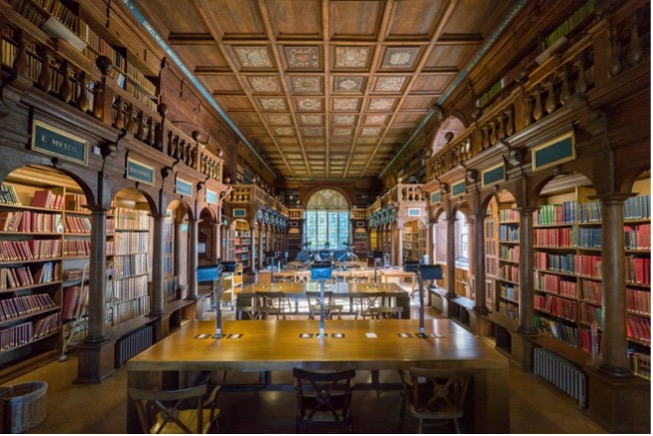
Bodleian Library – the transporting smell of old books!

The seeds of this journey go back to my graduate studies: I wrote my dissertation on the Roman War account in Thomas Malory’s Le Morte Darthur (written c. 1465 and printed by William Caxton in 1485). Malory altered the placenames and route from his source and then Caxton made additional changes in his print edition. Which made me wonder, naively: what was going on in terms of maps in the fifteenth century. Turns out: a lot. It was the beginning of world maps based on mathematical coordinates and the work of the first-century cosmographer Claudius Ptolemy of Alexandria. Think: north at the top (minus America).

Love maps? Good, there will be some geeking out about maps here. Check out the beautiful edition of Ptolemy’s Geography printed in Ulm, German in 1482, below.
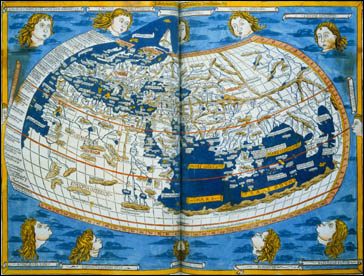
World map from the Ulm edition of Ptolemy’s Geography, 1482.
Source: Newberry Library

Three years ago, my research took me to a map seminar at the London Rare Book School, then to the triennial conference of the International Arthurian Society in Renne, France (in Brittany).  I hadn’t planned yet how I would get from London to Rennes, but I vaguely thought I would take a train and bus. 

While in London on a free weekend from the seminar, I decided to take a train to the small city of Winchester. In addition to its famed cathedral, the manuscript of Malory’s story of King Arthur was improbably discovered at a boys’ school there in 1934 (prior to that only the early print edition was known)! 

While crossing London’s busy Waterloo Train station, I passed through a shaft of sunlight slanting across the station platform, filled with tiny motes of sparking dust. Standing there, a thought occurred to me: Winchester is also the starting point of Malory’s Roman War tale. Amid my own personal uncertainty, came sheer happiness—I was Winchester bound.

Next weekend, I thought, I could go to York, which is the rather surprising second location in the tale. From there the story takes Arthur to the town of Sandwich in southeast England, over the channel, and, well, to Brittany—exactly where I am headed. In that moment, the idea coalesced: I’d follow the first part of the Roman War itinerary—from Winchester to York to London to Sandwich to Normandy to Brittany to Paris.

I was pretty much going that way anyway.
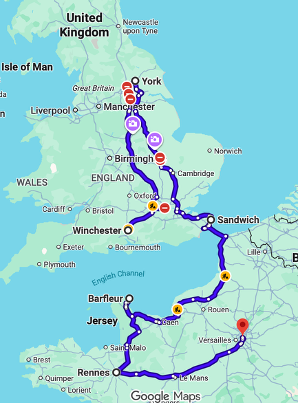
Next, a quick back story on the Roman War and itinerary. Then on to Winchester.

Books of Interest:

Thomas Malory, Le Morte Darthur (there are various editions; a modern language edition, edited by Dorsey Armstrong, or a retelling by Peter Ackyroyd, are the easiest to read).

Keith Lilley, City and Cosmos: The Medieval World in Urban Form

Keith Lilley, Mapping Medieval Geographies

Nick Millea, The Gough Map: The Earliest Road Map of Great Britain

Posted in Uncategorized | Tagged , , , , , , | Leave a comment

Quest

I am on the Eurostar train, streaming from London to Paris in just over two hours. My friend, Padeen, is dozing on a seat nearby. I’ve been awarded a faculty grant to follow the itinerary of the medieval story of King Arthur’s Roman War from England to Rome, an intermingling of my interests in medieval literature and geography. I began this journey/ quest three years ago in London and followed the route to Paris. Now, I am resuming where I left off and will travel by train, ferry, car, and foot to Rome and back to London.

Reading and topography is a nexus that can bring forth emotion, passion—thus the title of this blog: Passionate Geography. A landscape is replete with collective memories—it is a living portal to the past. And an experience of the living earth.

Photo Nathan Gallager. Courtesy of Eurostar.

I teach Marylhurst University, a small, non-elite liberal arts college in Portland, Oregon, a faculty position I’ve held for about 8 years. An Associate Professor of English (medieval lit, book history) and a self described provincial scholar, I live and work about as far away from the geography of medieval England as one can be.

Of course, when I decided to pursue a doctoral degree in medieval literature at age 38 with two young kids, there were, to put it politely, family skeptics. But here I am, just over the brink of 50, with a faculty position and a fellowship to follow the Roman War itinerary, a fictional journey in Sir Thomas Malory’s fifteenth century Arthurian epic, Le Morte Darthur (The Death of Arthur).

In Malory’s account, Arthur battles his way from London to Rome and back, a journey of approximately 3,500 miles.  It took Arthur and his men the better part of a year, but Padeen and I will drive and explore the route in somewhat less than a month. My older son is away for a wilderness skills camp at the Oregon coast and my younger son is at a one-month study abroad in Paris. Though a mom of teens, I’ll take the adventure.

Posted in Uncategorized | Tagged , , , , , , , | Leave a comment

In Malory’s Le Morte Darthur–a challenge is issued and a journey begins

It befell when King Arthur had wedded Queen Guinevere and fulfilled the Round Table, and so after his marvellous knights and he had vanquished the most part of his enemies–
. . . then so it befell that the Emperor of Rome, Lucius, sent unto Arthur messengers commanding him for to pay his truage that his ancestors have paid before him.

When King Arthur wist what they meant, he looked up with his grey eyes, and angered at the messengers passing sore.

–from Le Morte Darthur, by Thomas Malory.
Helen Cooper, ed. Oxford University Press, 1988.

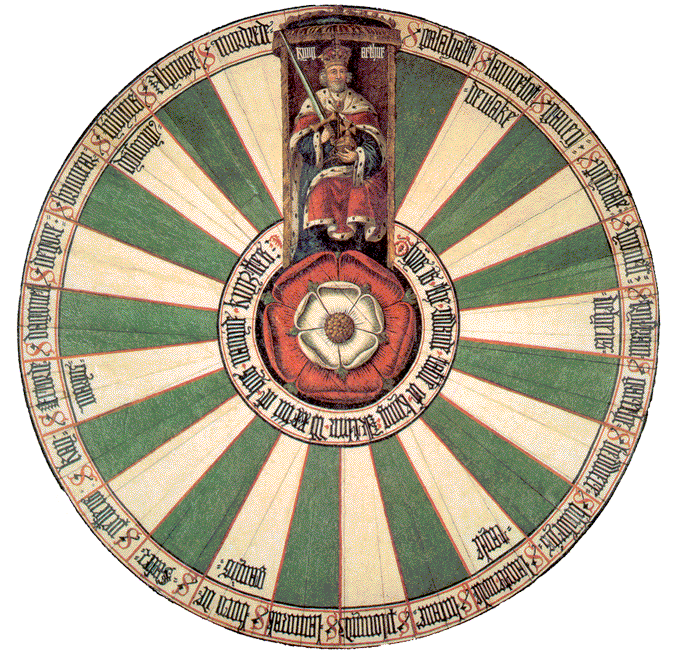
13th century Round Table, at Winchester

Sometimes, you might be feeling that things have come together in your life, that things are going well. Perhaps you are home, enjoying a meal with friends; perhaps you just got married or got a new job or have finally come into a good, stable place in your life. Then, something rocks the equanimity. In 2021, all I need say is “covid” to bring such a circumstance to mind.

In Thomas Malory’s epic tale of King Arthur, Le Morte Darthur, the young king has finally, exhaustedly, solidified his rule and he just married Guinevere (though Merlin told him not to). They are celebrating in Camelot with a comforting future ahead. Then, out of the blue, ambassadors from Rome come to Arthur’s court, demanding fealty, and a whole unexpected trajectory spins into play. Arthur will leave England with troops, battle his way across Europe, slay a giant, kill the Roman emperor, rest by Lake Lucerne, cross the Alps, besiege a city, and, ultimately, arrive in Rome. It becomes his defining action as king, and his journey defined mine as a reader.  I decided to follow Arthur’s route.

I write about the intersection of medieval literature and geography, of poets and astronomers.  My book Mirror of the World: Literature, Maps, and Geographic Writing in Late Medieval and Early Modern England was published by Routledge in 2021.

This blog chronicles my journey following the legendary route of King Arthur’s Roman War campaign, from Winchester to Rome.

To follow the journey, begin with the posts starting in January 2026 (reorganized from previous posts).

Posted in Uncategorized | 2 Comments

An update on Passionate Geography, January 2026

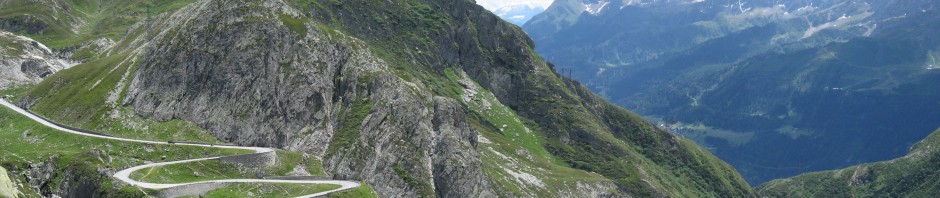
St. Gotthard Pass

Friends, if you once subscribed to this seemingly long-lost blog, you will start to see that I am tinkering and revising and hopefully finishing this project. If you would like to unsubscribe, please feel free to do so!

If you are willing to have another go at this journey with me, you will see that I am rewriting the introduction, with the story now beginning on the train to Paris, en media res. From there, I go back to the beginning of the journey in England, three years earlier. Once I get the first section (London to Paris) organized, I’ll be adding new posts that chronicle the journey from Paris to Rome (and back).

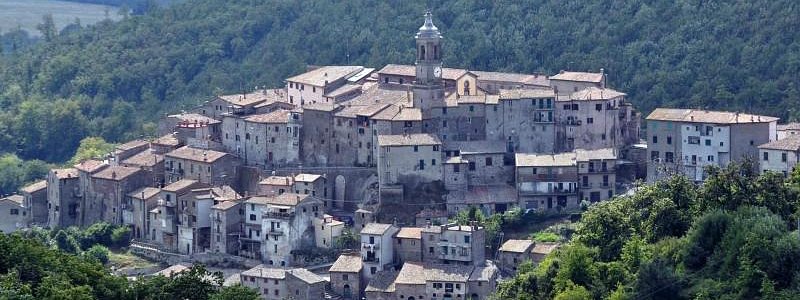
Latera, Italy

Some news: I’ve been selected for a writer’s residency in the medieval village of Latera, about 90 miles northwest of Rome! Thank you to La Casa Etruria Artist Residency. I’ll be in residence there for two weeks in May. Prior to that, I will be walking the final section of the Via Francigena from Viterbo to Rome, about 75 miles. The Via Francigena was a pilgrimage, trade, and diplomatic route that was first established in the 900s and that has been revived as a European cultural route.

Malory’s itinerary, the route I am following, roughly follows the Via Francigena and was no doubt informed by traveler’s stories from the way. I may set up a substack for that day-to-day journey (about a week of walking) that links back to here.

It’s been a continuing and incredibly rich journey; it’s good to have you along as I resume the story.

Posted in Uncategorized | Tagged | 3 Comments

a passionate geography

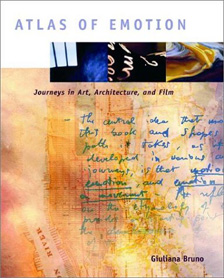
Between perception and a response emerges a zone of feeling, a resonance, a vibration, a powerful affect that inaugurates the passionate geography evoked in Guiliana Bruno’s ‘Atlas of Emotion’ . . . 

–Iain Chambers, “Maritime Criticism and Theoretical Shipwrecks,”  PMLA, May 2010

We think of geography as a science, a measuring of space: latitude, longitude, miles traversed.  But in life, as in fiction, geography is also passionate, resonant with memory or experience. In the everyday, we barely see our geography, but if you return to an old landscape, then your lost loved one, your sense of home, or bittersweet memories will ache your heart with pleasure or grief.

The genre of medieval romance is about the comings and goings of knights and maidens, of strange journeys and returns, of magical landscapes and horrifying battle.  In deciding to follow the story of Malory’s Roman War tale, I was romancing the Roman War, interpreting and experiencing the landscape of a very old story.  Transforming the story of a war into the story of falling in love with Rome.

But it wasn’t as if I set out with a plan. I found myself in the landscape; no, I created the circumstances of my being in the landscape, and then realized I was already on the route. For me, the journey became many journeys. Along the way, some heartbreak, a scholarly passion, the dream of so many pilgrims, travelers, and writers: Rome.

Guiliana Bruno
Guiliana Bruno, Atlas of Emotion
Posted in Uncategorized | Leave a comment