
Hit befelle whan Kyng Arthur had wedded Quene Gwenyvere and fulfyled the rounde Table, and so aftir his marvelous knyghtis and he had venquyshed the most party of his enemyes . . . And held a ryal feeste and Table Rounde with his alyes of kynges, prynces, and noble knyghtes, all of the Rounde Table . . . (113)
This is the opening of the Roman War tale. Arthur and Guenevere have recently married and members of the Round Table are gathered to celebrate both the young king’s wedding and his consolidation of power across England. The location of the royal feast is not specified here, but in the previous tale, Arthur is in Camelot:
And so within twelve days they [the knights] come to Camelot, and the Kynge was passing glad of their commyng, and so was all the court. Than the Kynge made hem to swere upon a booke to telle hym all their adventures . . . (111).
Where, exactly, is the mythic Camelot? Malory lands in favor of the real-world city of Winchester, and mentions several times that Camelot was at “that tyme called Wynchester.”
I arrive in Winchester on a cool July morning in a season that has not yet decided to be summer. After an inspiring week of lectures on the History of Cartography with Dr. Catherine Delano-Smith, and amazing sessions in the British Library map room with Maps Curator Peter Barber, I am breaking out of London. I swear upon Malory’s great book to tell you all my adventures.
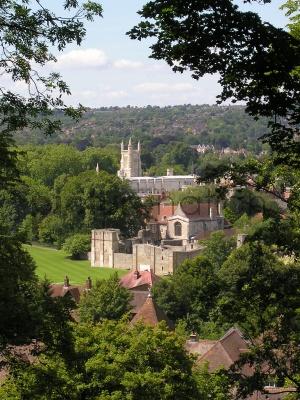
Winchester is an important literary home of Malory’s great tale on several counts:
- Malory’s identification of Winchester as the ancient seat of King Arthur.
- The discovery of the only known manuscript of Malory’s Le Morte Darthur at Winchester College, a private boys’ school established in 1382. The manuscript, discovered in 1934, is dated to 1470-83.
- The magnificent 13th century Round Table on display in the Great Hall.
- The 11th century cathedral with its late-medieval Gothic nave.
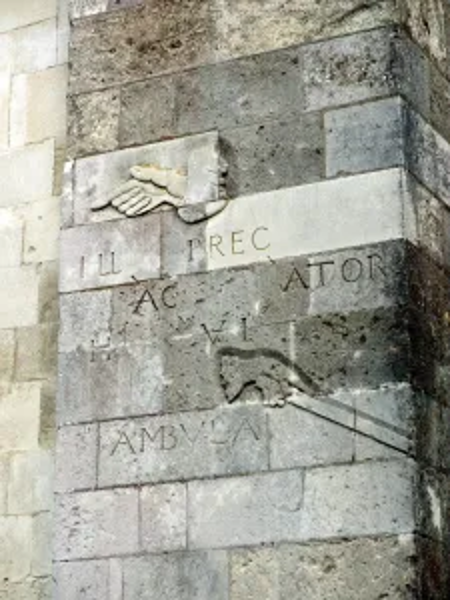
- The pointing hands (known as manicula) carved into an exterior stone wall of Winchester Cathedral in 1633. To my eye, the cathedral manicula replicate the manicula that appear in the margins of the Winchester manuscript of Le Morte Darthur, where they point out important passages or names.
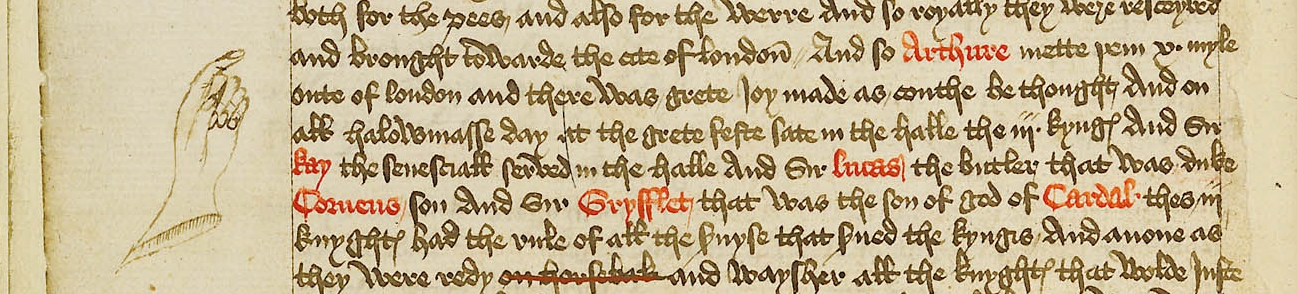
Source: Malory Project, British Library.
I can see why Malory favored Winchester as the site of Camelot— it is a perfect mingling of ancient Roman and medieval English cultures: it evokes both the fictional Arthur’s historical moment, around the mid-5th to mid-6th centuries in the waning days of Roman rule, and Malory’s use of the anachronistic medieval present. In Malory’s time, in the mid-1400s, traces of the former Roman presence still remained—evidence of a Roman fortification on St. Giles Hill and beautiful roman floor mosaics, still visible today.
The town name “Winchester” seems to be a mingling of English and Roman place names: the older form of the town name, Wintanceaster, is a combination of the Latin word “venta” (perhaps meaning “market”) and “ceaster,” the Old English word for “fortified town.”
The magnificent Winchester Cathedral is the centerpiece of the city, but for a reader of Malory, the manicula, Winchester College, the massive Round Table, and traces of the Roman occupation together evoke the setting that inspired Malory to establish Winchester as the starting place for his tale of Arthur’s Roman War.
Further Reading:
Thomas Malory, Le Morte Darthur (c. 1465). Note: page numbers are from the edition by Stephen Shepherd.
Thomas Crofts, Malory’s Contemporary Audience (2002). Crofts provides an elegiac interpretation of the shields and manicula in the manuscript.

 A Passionate Geography: Romancing King Arthur’s Roman War