
An intriguing aspect of Winchester Cathedral, aside from its beautiful interior, medieval nave, and as the resting place of Jane Austen, is the manicula (pointing hands) carved onto an exterior wall in 1633. To. me, the carving forms a kind of map: roughly translated, it states, “That way thou who comest to pray. This way thou who are pursuing thy walk.” Apparently, a bishop at that time wished to instill a more reverent atmosphere in the churchyard, but the grammar “this way” seems to encourage the more secular choice and leads, coincidentally (??), to where Malory’s great work lay hidden for centuries.
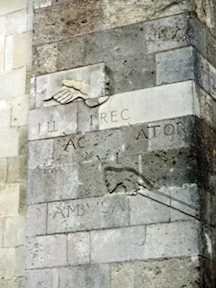
The inscription calls to mind an incident when I was about six at the Catholic school I attended in Rio de Janeiro. The nuns in their imposing full habit—it was 1963—were strict, meting out a swift and severe justice. A concrete play area fronted both the school and church chapel. One day, holding hands with a kindergarten friend, we blithely skipped alongside the exterior of the chapel. Spotted by one of the nuns, we were chastised with the same seriousness of the inscription on the Cathedral. No skipping– or joy–near a solemn house of prayer! The rules are absolute.
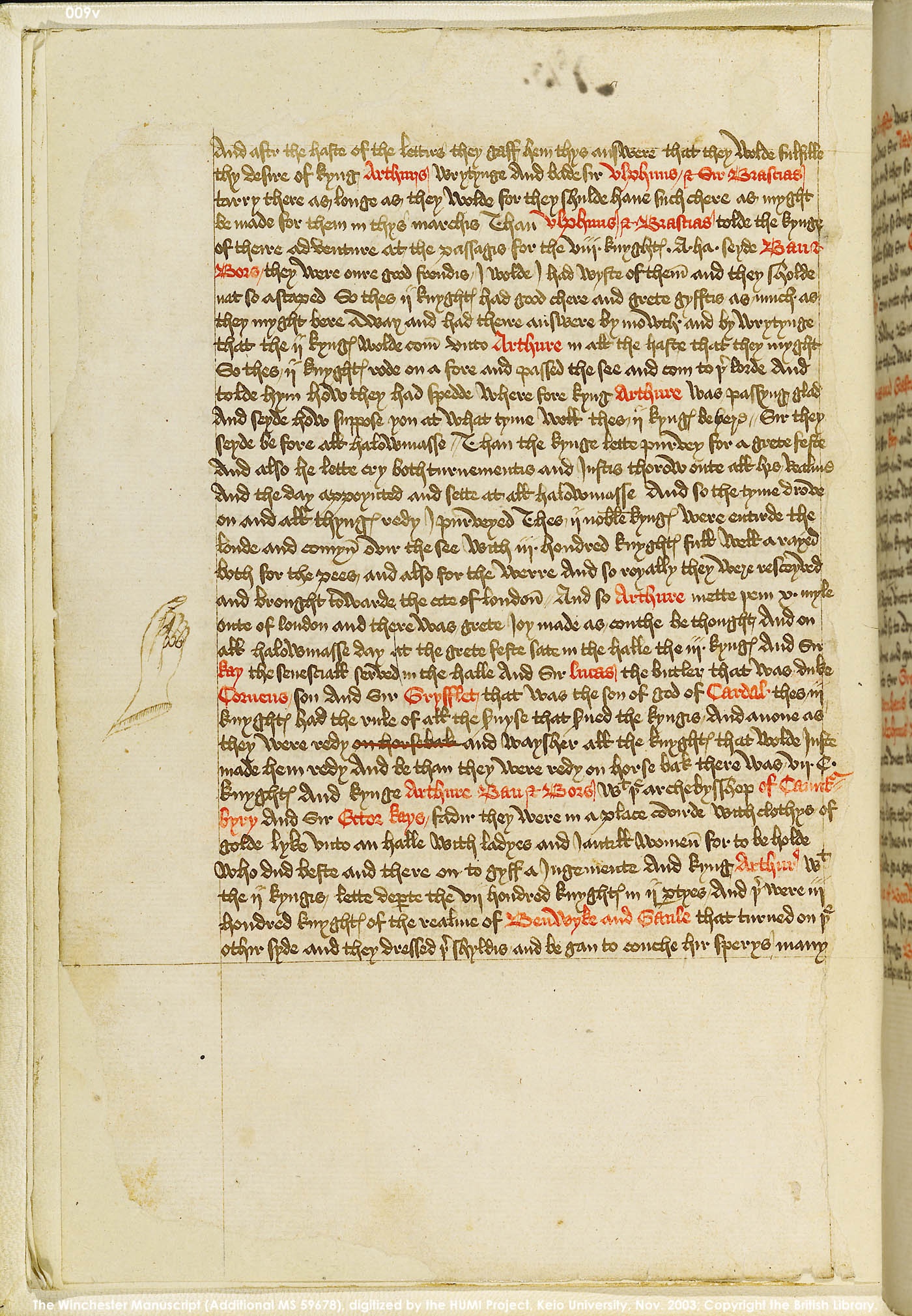
With that experience seared into my young heart, I veer away from the Cathedral (though, in truth, it is a beautiful, welcoming space) and follow the pointing hands in the direction of a grassy garden area, then turn left onto a quiet street that runs nearby, past Jane Austen’s one-time home. I come to the heavy wooden doors of Winchester College, a boys’ college preparatory school founded in 1382, where the manuscript of Malory’s Le Morte Darthur was discovered in 1934. On the manuscript pages, the manicula point out a knight’s death or important narrative point.
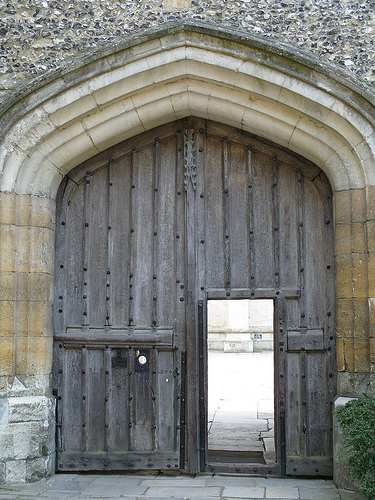
Standing outside the college’s massive wooden door, I look up to the left to see the Warden’s lodging, the place where Malory’s manuscript rested for 500 years. Pushing the heavy door, I stepped inside and checked in for my tour at the porter’s gate.
Note: Yes, there is the pop tune from the 1960’s that now maybe lodged, unfortunately, in your brain. It has nothing to do with Malory or manuscripts or manicula (the lyrics blame the cathedral for the singer’s lover leaving him–seems the cathedral suggests lifepath choices).
Further Reading:
To see a digital facsimile of the manuscript and of printed book of Thomas Malory’s Le Morte Darthur, the British Library’s Malory Project, digitized by Keio University’s HUMI Project is a treasure trove.

 A Passionate Geography: Romancing King Arthur’s Roman War
Thanks for reading, Saania!