
[Reader, if you are just joining this journey, click on the “About” tab for context. The chronological posts begin in January 2026.]
If Malory’s references to Winchester as Camelot, his locating the start of the Roman War campaign there, and the presence of the 15th century manuscript of Le Morte Darthur at Winchester weren’t ENOUGH to tightly link Winchester to the Arthurian legend, there is also a massive and magnificent “table rounde!”
Probably no greater icon of the Arthurian story exists than the Round Table, a symbol of Arthur’s investment in fellowship and in preserving the peace through an equality of knights. In literature, the Round Table has its earliest appearance in Wace’s 12th century Le Roman de Brut and over time its significance was adapted. John F. Kennedy loved the 1960’s musical Camelot which amplified the Round Table as a symbol of democratic idealism. Monty Python’s Holy Grail version, of course, has a more cynical take.
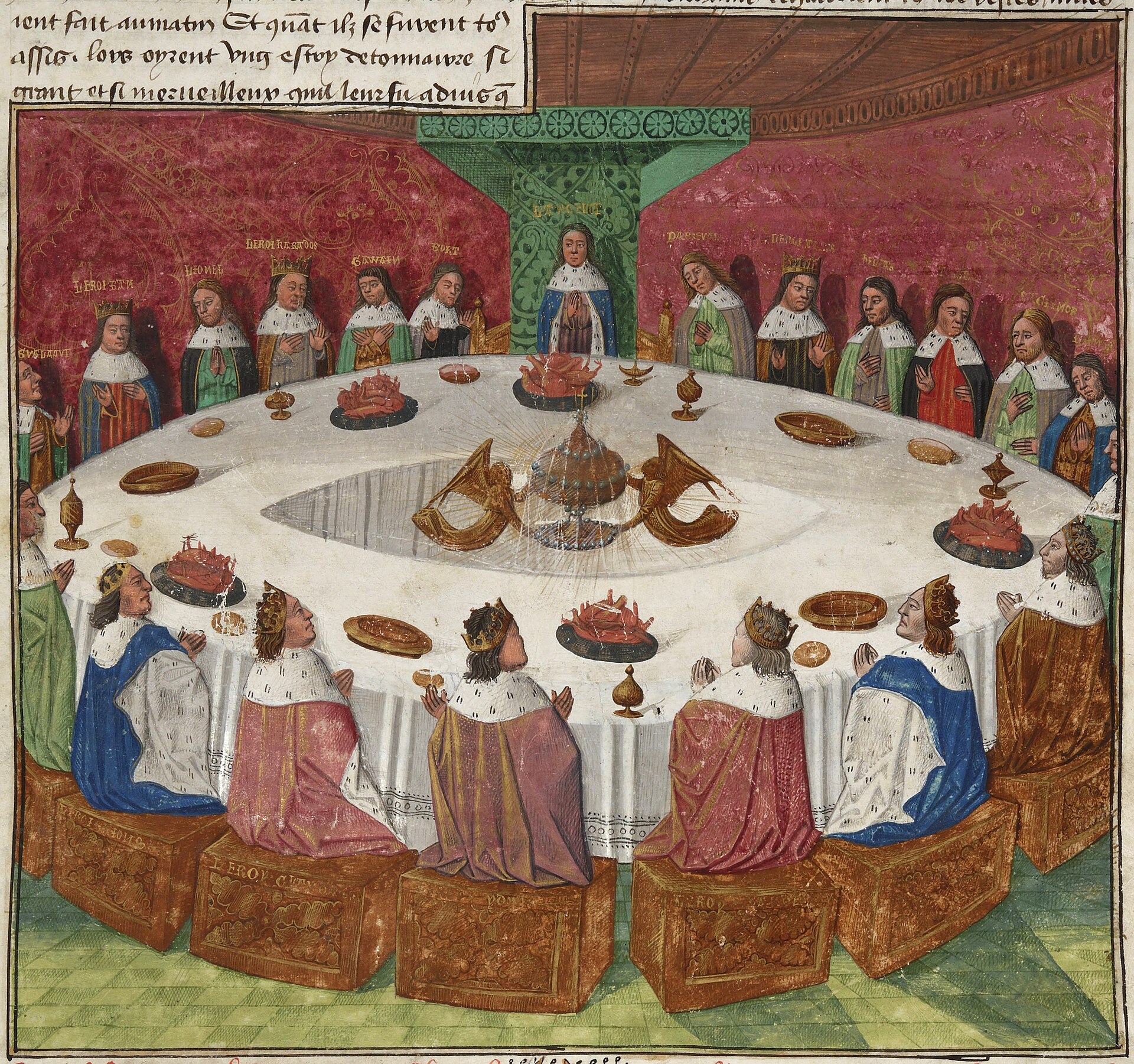
Here are two references to the Round Table in Thomas Malory’s Le Morte Darthur:
“I shall gyff [give] hym [Arthur] the Table Rounde [said King Lodegreanus,] which Uther hys fadir gaff me. And whan hit ys fulle [it is full] complete there ys an hondred knyghtes and fifty . . .” And so Kynge Lodgreaunce delyverd hys doughtir [daugheter] Gwenyvere unto Merlion, and the Table Rounde with the hondred knyghtes . . . (77).
Hyt befelle whan Kyng Arthur had wedded Quene Gwenyvere and fulfilled the Rounde Table, and so aftir his mervelous knyghtis and he had venquyshed the moste party of his enemyes . . . he rested and helde a royall feste and table rounde with his alyes of kynges, prynces, and noble knyghtes all of the Rounde Table (145).
Note: spelling was flexible in the Middle Ages!
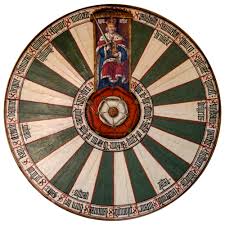
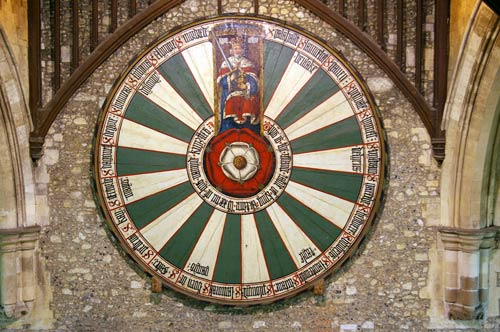
Thought by some to be THE round table, the Winchester round table has ultimately been shown to be made of oak from the 13th century. Too late to be Arthur’s–but still an impressive, heavy, medieval round table! Measuring 18 feet in diameter and weighing over a ton, the table is now displayed in the Great Hall of Winchester Castle and has been part of the town’s history for centuries.
In Malory’s story, the ‘Table Rounde’ was a gift from Guinevere’s father to Arthur in celebration of the marriage (he “delivers” Guinevere and the table, minimizing the distinction between bride and furniture delivery!). There is a sense in Malory’s Roman War account that the table creates a convivial setting during a period of relative peace and joyfulness.
Although not nearly as old as the presumed time of King Arthur (approximately 6th century), its mystique inspired an association with the King Arthur legend and may have inspired Malory to identify Winchester as Arthur’s Camelot. During the reign of Henry VIII, just 50 years after Malory had written his great Arthurian story, the table was painted in the scheme that is seen today: a bold green and white patterning with the names of famous knights of the Arthurian court.
The massive table is now hung at one end of the Great Hall, visually linking the city of Winchester with Tudor kings and the legend of King Arthur. I peer through an archway to find a lovely reconstructed medieval garden.
A 2010 excavation at the cathedral city of Chester suggested to archeologists that Chester, not Winchester, may have been the “Camelot” of the historic English warrior-king and that a Roman amphitheater there may have been the inspiration for the legendary symbolism of a round table. But Malory’s textual reference to Winchester, the manuscript, and round table all accumulate a mythology that Arthur’s sparkling court began in Winchester.
In my own family, my husband, Vietnamese foster sons (Nam and Long) and biological sons (Conor and Nico) have gathered around our common dinner table (a farmhouse rectangle) for years, sharing the highs and lows of the day. Nam and Long now have jobs and children of their own while Conor will be starting his last year of high school come fall. Nico will be a freshman, the one year the brothers will spend together at Central Catholic High School.
In Tennyson’s Victorian poem Idylls of the Kings, the young knights of the Round Table are dispersing, in search of the grail and adventure. Our young men are also heading out on adventures of their own. And like Tennyson’s wistful Arthur, we are wistful at the thought of changes and uncertain how they impact us. These dinner gatherings are dear to us, and each impending vacancy keenly felt.
There are plenty of hours left on this July day, so I depart the Table Round and head for St. Giles hill, where I hear a trace of Winchester’s Roman past remains.
Further Reading:
Jon Whitman, “National Icon: The Winchester Round Table and the Revelation of Authority” in the journal Arthuriana 18:4, Winter 2008.
Peter Field, editor, Thomas Malory: Le Morte Darthur (2013). All Malory quotations are from this edition.

 A Passionate Geography: Romancing King Arthur’s Roman War
Thanks, Meg. This was fun to read and centered me today whilst facing our current world. Onward!