
[Arthur] seyde to them [the Roman ambassadors who were demanding taxes] in thys wyse,“Now sey ye to youre emperour that I shall in all haste me redy make with my keene knyghtes . . . And I woll brynge with me the beste peple of fyftene [fifteen] realms, and with hem ryde over the mountaynes in the maynelondis [mainlands] . . . and syth [then] ryde unto Roome with my royallyst knyghtes (147).
In other words, the young Arthur will not only NOT pay Rome but will, instead, attack it. He held a council with his noble knights in a nearby fortified tower to make the decision.
In addition to placing Arthur in Winchester at the start of the Roman War episode, Malory also establishes Arthur as having a claim to Roman ancestry to legitimize his rebuff of Rome’s demand. Not surprisingly, traces of Roman culture permeated medieval Winchester, including Roman mosaic floors such as those now displayed at the Winchester City Museum. I find myself mesmerized by the detail and pattern of the mosaics. They provide a glimpse of the domestic side of the Roman Empire’s occupation of Britain: people’s feet trod this floor daily! I learn there is an earthen outline of a Roman fort on St. Giles Hill, so I let my curiosity lead and decide to hike up to find it.
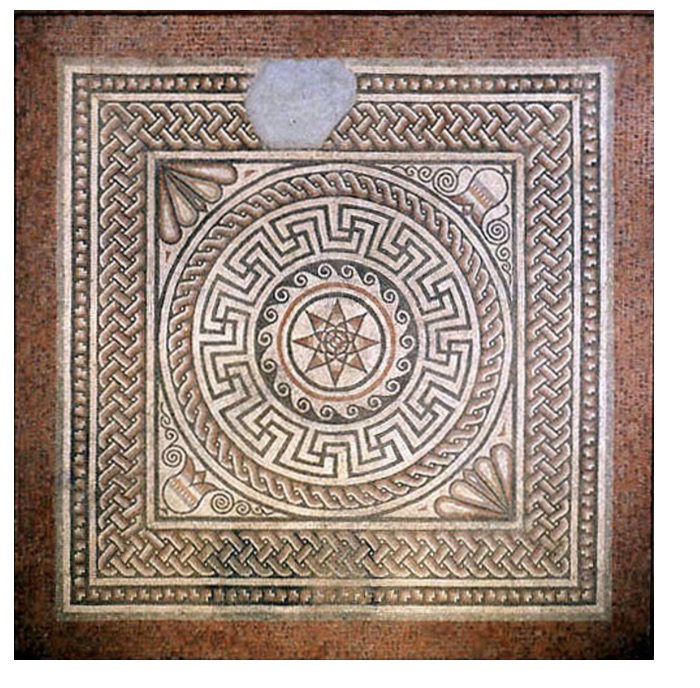
Photo credit: Hampshire Cultural Trust
As I begin the hike, I meet a World War II veteran. How delightful to come upon an older person when out walking; they are often open and willing to spend a few minutes chatting. Our Veteran takes his daily walk here on the trails. In his right hand, he clutches a burnished wooden walking stick with a gnarled top. “Where are you going?” he asks.
A former navy man, he tells me that his first tour of duty took him around the world but, he adds, “I wouldn’t live anywhere else but here in Winchester.”
“You are too young,” I venture, “to have been in World War II?”
My own father was a young, fit seaman in WWII and, at 86, passed away two years ago. This veteran tells me his well-rehearsed response to my question: “When I joined up, Hitler capitulated.”
We laugh, and I rejoin, “Britain has you to thank.”
He asks me once again, reminding me of my own father’s struggle with Alzheimer’s, “Where are you going?”
“Up to the top,” I say.
He again points out the path that I should take. I am grateful for his guidance as the trails between city and hill are not well marked and, with bits of urban debris strewn about and overhanging bushes, the trail is a slightly disconcerting space for a woman walking alone.
He tells me there is an outline of a Roman fort at the top. “This was once the capital of England,” he says with pride, “and King Arthur was the first king.”
Though he had forgotten where I was going, he had not forgotten Arthur—a mythical presence from almost 1500 years ago. Arthur may be the “first” king in our modern conception of English history, but he is not the historical first king of Britain. In Geoffrey of Monmouth’s 12th century History of the Kings of Britain, you can read a quasi-historical record of the rise and fall of pre-Anglo-Saxon kings. In that text, Arthur is just one of the legendary rulers.
High above the city, under a sky threatening rain and lightning, the hilltop affords sweeping, panoramic views of the town and landscape. No wonder the Romans chose this lofty site from which to survey and dominate the lush surrounding countryside, and no wonder it served as a plausible location for Camelot in Malory’s imagination.
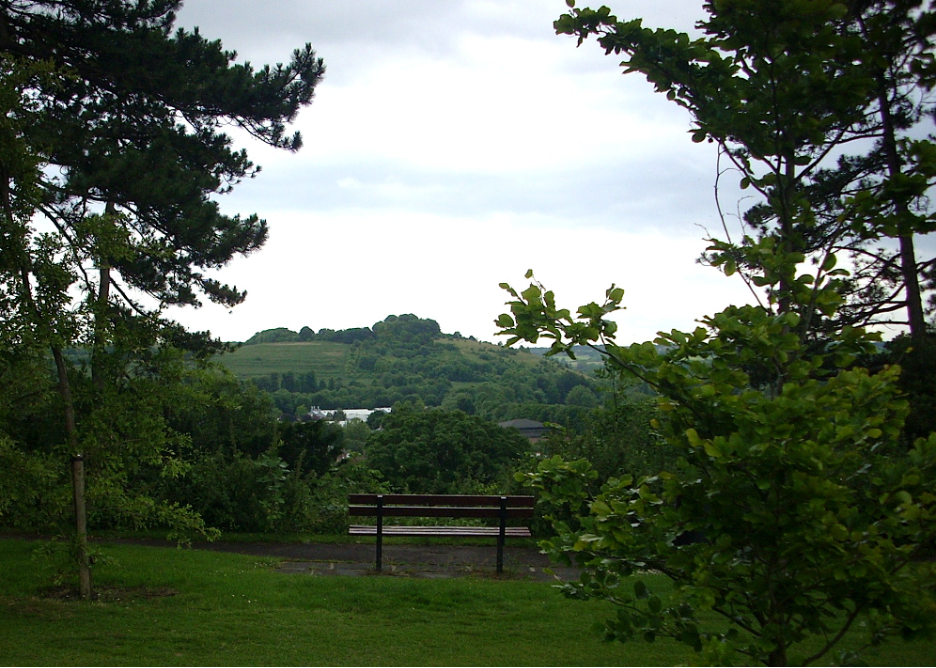
But at the top I find no trace of the Roman fort—only a softly mounded green hill, fringed with trees. Looking down on the city, I see the limestone Cathedral, a bright contrast to the red brick of the modern town buildings.
At first, I am the only one in this green monument of the past, but soon I see an older woman sitting on a park bench, looking out onto the rolling hills. Her white hair and light-yellow jacket create a bright patch of color in the gathering gray of this July day, a summer that will not come. She sits pensively, ignoring the misty clouds.
The Roman centurions could not have imagined her, lightly sitting on a bench built on ground they trammeled underneath, amidst the clamor of sword and horse and sweat. In the moment, I feel a sense of the uncanny: she an older shade of my solitary self, or I a younger version of her solitary self. She is a hummingbird in a moment of stillness.
For further reading:
Charlotte Higgins, Under Another Sky: Journeys in Roman Britain (2014).
Guy de la Bédoyère, Roman Britain: A New History (2014).

 A Passionate Geography: Romancing King Arthur’s Roman War