
[Reader, if you are just joining this journey, click on the “About” tab for context. The chronological posts begin in January 2026.]
Now leve we Sir Lucius and speke we of Kyng Arthure . . .

Mikhail Bahktin refers to the chronotope—the interplay of time and space in literature. In following this journey, I’m breaking out of—or into—the time and space of the book.
On the train back to London, I idly wonder– in what season is Malory tale set? It seems to be around Christmastime.
The Roman ambassadors, who had traveled to Winchester on behalf of the fictional Roman emperor Lucius, intrude upon the festivities with the emperor’s demand. The young King Arthur counters that he has read the “cronycles of this londe,” drawing on Geoffrey of Monmouth’s Historia, in which the Breton kings Belinus and Brennius conquered Rome before Julius Caesar even thought about invading Britain. So, no, Arthur is not going to comply. With his “ferse [fierce] men of armys [arms]” he will, instead, reclaim and conquer Rome for Britain.
The sense of time is expansive here. The episode draws upon a reading of the ancient past to justify the present and to make a claim about the future.
Arthur gives the Roman ambassadors just seven days to depart Britain; they must travel from Winchester to the port town of Sandwich and on to Rome to deliver Arthur’s message. The narrative describes the simultaneous-in-time actions of the Roman Emperor Lucius’ once he hears of Arthur’s refusal. Lucius masses an army, filled with allies from places such as “Arabé” and “Turké,” and marches out of Italy intending to meet Arthur’s forces on the plains of Burgundy.
The text then returns to Arthur:
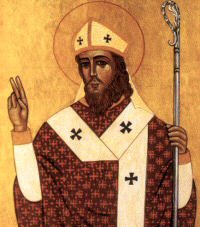
Now leve we Sir Lucius and speke we of Kyng Arthure that commanded all that were under his obeysaunce [rule], aftir the Utas of Seynte Hyllary that all shulde be assembled for to holde a parlement at Yorke, within the wallys [walls].
Utas? I have to look up it.
It turns out that the term “utas” refers to the eighth day of a feast day (related to the term octave), and, as St. Hillary’s feast day is January 13th, this means the parliament is to be held in York on January 20th. Therefore, the festive gathering for the wedding had indeed been held during the Christmas and New Year holidays.
While much of Le Morte Darthur is set in a hazy, unspecified ‘romance’ time, Malory brings in touches of emerging realism in terms of geography. By the mid-fifteenth century, ideas about mapping were undergoing a transformation based on the work of the second-century Alexandrian cosmographer Claudius Ptolemy. In these new maps, distance is represented as a function of time (that is, latitude and longitude). These principles mark the beginning of our modern cartography practices.
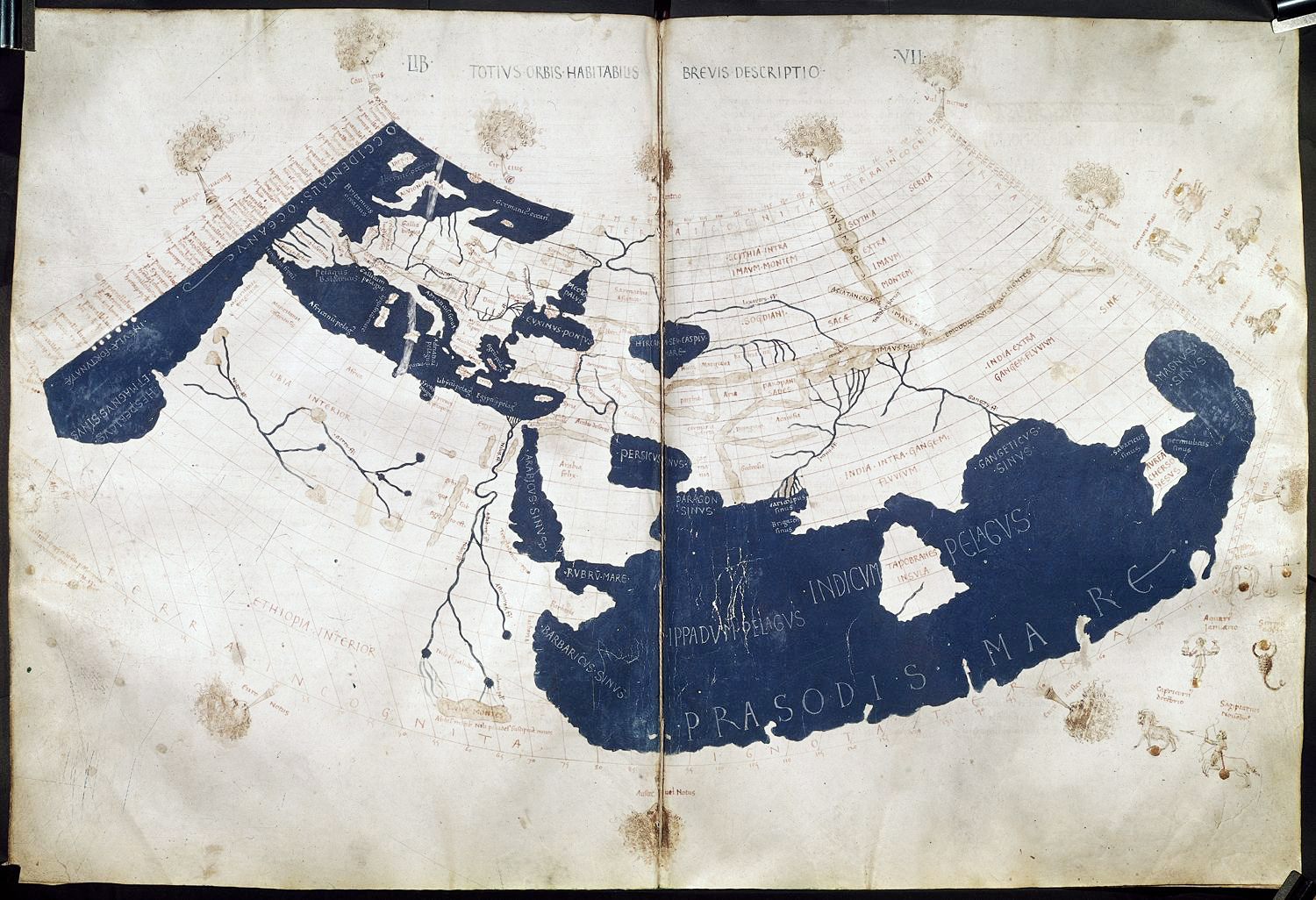
Literature, much like maps, is concerned with time and place. Malory is renowned for how he took myriad French and English tales of the adventures of Arthur or his knights (think of the Star Wars’ episodes, prequels, tangents, sequels) and shaped them into a single, linear narrative of “the birth, life, and death” of King Arthur. Malory also tries to wrangle mystical romance time into specific mileage between locations and provides specific town names, telling us, for example, that Arthur’s Camelot “ys [is] in Englysh called Wynchester.”
Based on the “utas of Seynte Hyllary” reference, it is early January in the tale and, by the end of January, Arthur will hold his parliament in wintry York. Be there, in other words, by January 20th. For me, it is a cool and damp July. I arrive back at Waterloo train station and purchase a next-day ticket to York.
Further Reading:
Ptolemy, The Geography, Cosimo edition, (2011).
Meg Roland, Mirror of the World: Literature, Maps, and Geographic Writing in Late Medieval and Early Modern England (2021).
Elizabeth Evans, ed. Space and Literary Studies (2026).
All citations are from Thomas Malory, Le Morte Darthur, P. J. C. Field, editor (2013).

 A Passionate Geography: Romancing King Arthur’s Roman War